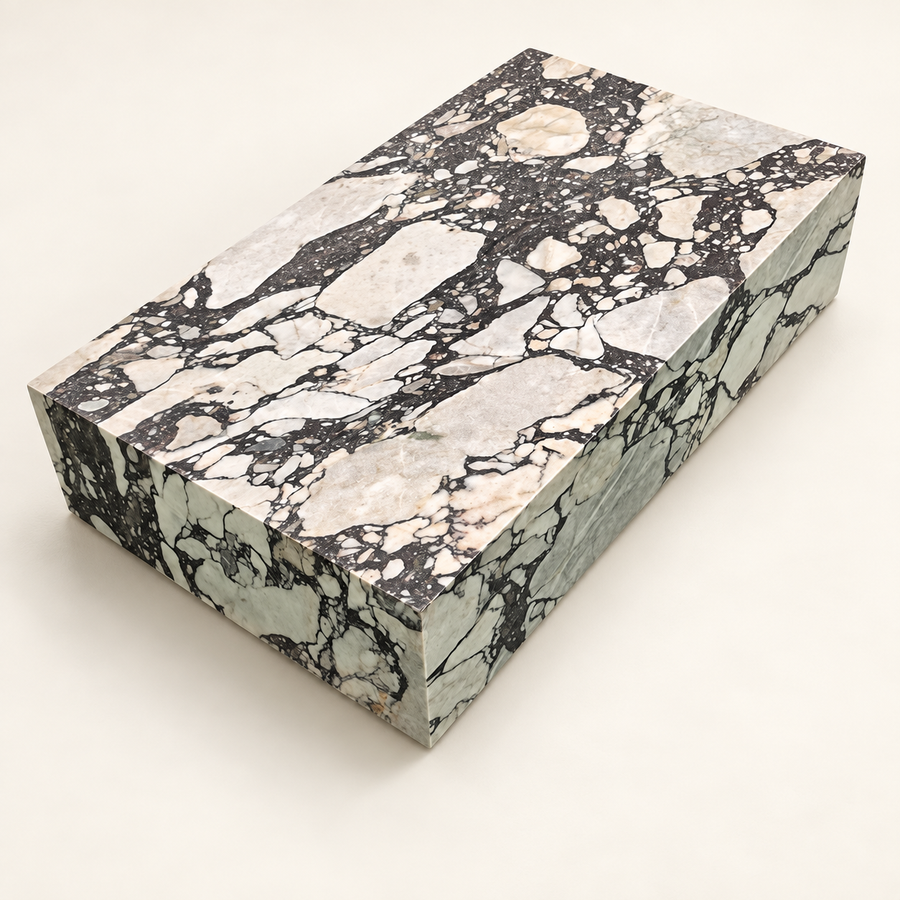
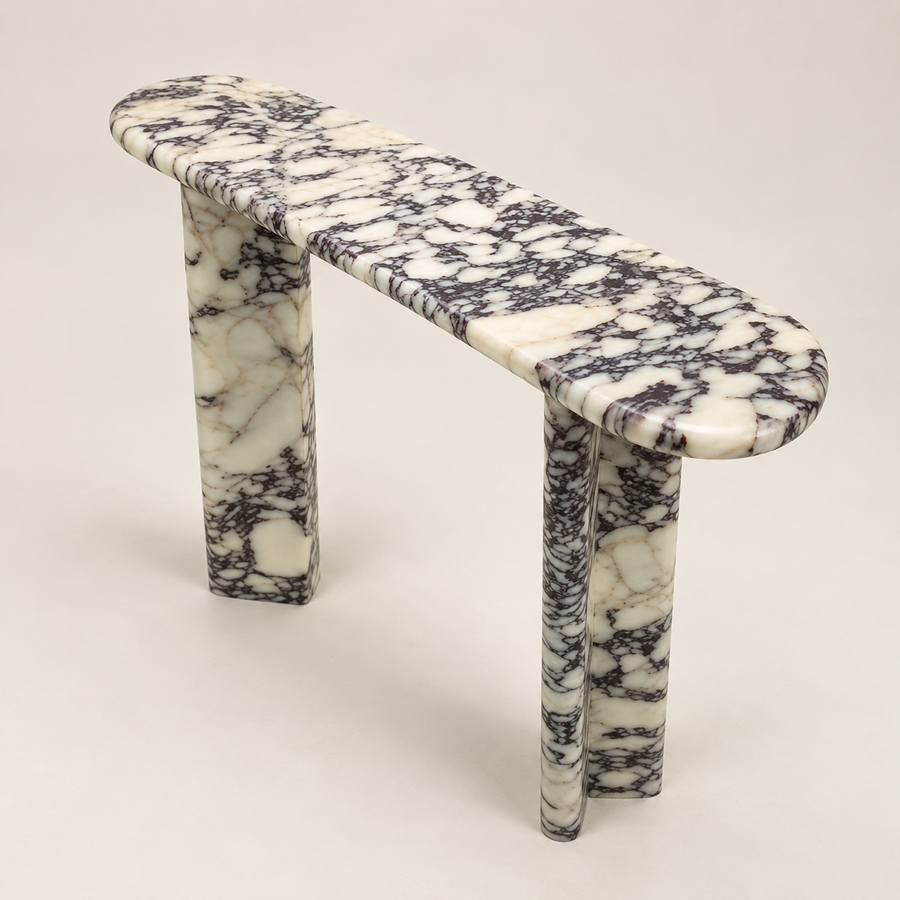
What Calacatta Viola looks like
Most marbles people know are white or grey. Calacatta Viola stands apart: a pale, creamy ground crossed by veins from violet to wine red, sometimes with darker grey. The veins often break the stone into fragments, so descriptions call it "brecciated" or "breccia-like".
House & Home describes designers choosing it "as a fresh alternative to the more neutral marbles, like Carrara". Because every block is different, no two pieces carry the same pattern.
Italian or Turkish?
Sources agree the original stone is Italian, quarried in the Apuan Alps of Tuscany. Some place it around Carrara, others in the Vagli area, about 30 km away.
Stones with a similar look come from Turkey and other countries and are often sold as "Calacatta Viola" too. According to two stone companies, the Turkish stone tends to be warmer and softer, with veins that blend more, while the Italian one is sharper and higher in contrast. Both sources sell stone, so read this as a general tendency.
| Italian Calacatta Viola | Turkish "Calacatta Viola" | |
|---|---|---|
| Origin | Apuan Alps, Tuscany | Turkey (one source cites the Afyon region) |
| Look, according to sellers | Crisp white ground, sharp violet and burgundy veins | Warmer or greyer ground, softer, more blended veins |
| Price, according to sellers | Higher; described as rare and scarce | Lower at the quarry |
Good to know Our Viola Plinth Coffee Table and Viola Console are in Turkish Calacatta Viola, as their pages say. For other pieces, ask us about the stone before you order: we will tell you what we know about the block.
How to style it
A stone this expressive works best when it is the only strong pattern in the room.
- Dark and warm woods. Isabella Pacelli of Roundhouse suggests "rich dark colored cabinetry and dark timbers — especially walnut". Greg Walton of Studio McW says timber "acts as an emollient, softening what might otherwise feel ostentatious".
- Mid-tone woods and gold tones. House & Home notes that the stone's warmth "pairs well with mid-tone woods", and that its creamy tones suit gold-toned fixtures.
- Quiet surroundings. Plain walls, one other material, soft textiles in neutral or deep tones. Let the veining do the talking.
- Start small if you are unsure. A tray or a vase in Calacatta Viola brings the colour into a room without committing a whole wall to it.
Where to use it at home
| Where | Why it works | Our pieces |
|---|---|---|
| Living room | A coffee table shows a wide surface of stone, seen from every seat | Viola Plinth, S$2,990; Faceted Calacatta Viola, S$2,190 |
| Entrance | A console is seen first and used lightly | Viola Console, S$1,890 |
| Beside the sofa or bed | A small dose of colour | Round Drum, from S$599; C-Frame, S$1,090 |
| Bathroom and dressing table | Small objects, easy to change | Ribbed Soap Dish, S$39; Oval Vanity Tray, S$69 |
Caring for Calacatta Viola
It is a marble, so acids etch it: lemon, wine and vinegar leave dull marks on the polish. Stone distributors describe its acid sensitivity as high and advise against acidic or abrasive cleaners. Wipe spills quickly, use coasters, and clean with warm water and a pH-neutral product.
If a mark appears, our article on etch marks and water rings explains what to do, and our care guide covers everyday cleaning.
Which Calacatta Viola piece for you?
- If you want a statement in the living room → a coffee table. Viola Plinth →
- If you want colour at the entrance → a console. Viola Console →
- If you want a small dose → a side table from S$599. Marble side tables →
- If you want to try the colour first → a tray or a vase from S$49. Stone trays →
- If you are comparing stones → Marble, travertine or onyx →
Questions
What is Calacatta Viola marble?
A marble with a white to cream ground and violet, burgundy and plum veins, originally quarried in the Apuan Alps of Tuscany, Italy.
Is Turkish Calacatta Viola the same stone?
No. It comes from Turkey and has a similar look. Stone sellers describe it as warmer and softer in contrast, and one seller's figures put it well below the Italian stone at the quarry.
Is Calacatta Viola expensive?
The Italian stone is described as rare and in the upper price range for marble. Prices of finished pieces depend more on size, thickness and work than on the stone alone.
Does Calacatta Viola stain or etch?
It etches with acids like every marble, and can stain if spills are left. Coasters, quick wiping and a neutral cleaner keep it looking right.
What colours go with Calacatta Viola?
Designers pair it with dark or mid-tone woods such as walnut, and with gold or brass tones. Keep the other surfaces quiet.